
That’s DEFUND, not defend. Why do their actions so often suggest that arts, culture, education, parks and youth programming have no future, when if we will have a local future, these will be the places it is found?
Here we go again. In my home province of Nova Scotia, where just under a million citizens live, the ruling provincial conservatives have racked up more than a billionaire dollars in deficit spending this year.
Where did the money go? They inherited a surplus!
Their response has not been to change course, to rethink their favoured strategy of subsidizing big development and extraction projects, where, as we’ve seen again and again, the promised jobs are fewer than forecast and often short-lived; the environmental and health impacts often grave (including environmentally caused cancers, arsenic in the watercourses downstream); the impact on roads and other built infrastructure often more costly than monies brought in, year over year; and the much vaunted profits flow primarily offshore into the pockets of foreign owners, who pick up and leave when the going gets tough.
No. When the strategy of tendering contracts to liars standing next to holes in the ground, as Mark Twain so famously described gold mining proponents, fails, repeatedly, what do they do? They seem to be persuaded that if they invest more, invest bigger, the hole in the ground will at last produce—coal will become gold; gold will herald a new age of excellent employment; Liquid Natural Gas (LNG) plants or hydrogen fuel plants or rocket launch pads will employ everyone, and at last the province will be able to afford the healthcare everyone deserves. Never mind that among the usual knock-on effects of big extraction are more demand for acute sickness care, not wellness. As a provincial financing strategy big and dirty is a bottomless pit of a losing proposition. Nevertheless, they carry on.
So, great new budget balancing idea #1, keep extracting. More and bigger. Every apparent big pants salesman who can offer a little trip to Scotland or Tasmania or Chile or Texas is welcomed, offered “proponent” funding (“you have to spend money to make money”), and worst of all, believed, even when their so-called environmental assessments are, as we saw when fighting open net pen salmon farming, routinely cut and pasted from other jurisdictions entirely.
Great new budget balancing idea #2 then runs like this: “We’re in debt; we all have to share the pain.” They’re not talking about reversing their tax cuts or increasing the rate on wealthier individuals or corporations. They’re not counting the environmental costs of their wonderful new/old diggery plans. No. Those aren’t even real are they? They’re what the old fashioned economists call “externalities,” meaning (like the massive human and environmental costs of warfare) stuff that we don’t have to enter into the columns of our economic calculus, so for accounting purposes, null.
Because the people who need to “share” most in this scheme to save for a better future in Nova Scotia are youth, educational institutions, wellness initiatives including parks and wilderness spaces, and the arts and culture. Because clearly, there’s no hope for the future in any of these things. These are evidently extras, things that can be spared, despite the fact that these provincial sectors bring more than $1.5 billion annually to the provincial economy, and clearly contribute to health and wellness, as well as to making the province a desirable place to live.
But in the eyes of provincial conservatives, none of that counts. They’ve cut $100 million from these “soft” sectors this year—not nearly enough to help address their $1.2 billion deficit, but enough, especially coming as these cuts did in a sort of Blitzkrieg, to completely wreck numerous initiatives so that they may cease to function entirely, thereby killing the proverbial golden goose that arts, culture, education and youth wellness projects represent. If these sectors, which make do on shoestrings, keep their earned monies in the province, and export and invest in the future of stories, music, ideas, education, youth resilience, land stewardship, local history, love of Nova Scotia, etc. are weakened or killed off this year, what will be around to help fund next year’s budget? Or to cut when the set of promises to liars standing next to holes in the ground continues to balloon out of control?
Why do youth, arts, education, parks spell “no future” to provincial conservatives? What is wrong with them? Why is the past of big over-budget digs the only future they can imagine?

In 2014, in another period of extreme and extremely stupid austerity that, as now, targeted genuinely sustainable projects for cuts, I wrote and sometimes performed a poem I called Against Usefulness. I share it below, should anyone want to chant or repeat or riff off it. And if you invent new verses or write your own poems, please share them with me!
Against Usefulness
If your useful abolishes poetry, I call for the end of utility.
How long can we live without dreaming?
Could you think if you didn’t drift?
What about a patch of colour on winter’s blankest day?
Tell me you don’t eagerly anticipate spring:
how long can you last without hope?
Useful.
Is your house but white walls and rooms of emptiness?
Does your coat have a check, a fanciful button, a bit of flair
or style?
What about your shoes?
Off with anything you don’t stringently need:
for you, sackcloth, black rubber boots, the plainest of hats.
Do you like to look from your window, to follow the arc of a bird in flight?
Drop your eyes now; stare at the square of your desk:
this is your world entire.
All else is uselessness.
Take the salt from your table.
Seek no new flavours, palate teasers, surprises or adventures.
Who needs food or fetes or dinner meetings? Focus on the task.
As for the rest? Try Ensure.
Now empty your shelves,
your music library.
Strip the paintings from your walls.
Give away your television, your rings and baubles, your photographs,
the bottle of porto at the back of the cupboard,
your mother’s favourite coffee cup,
every extra jacket.
Leather? Utterly impractical. Toss that too.
Strive for flatness in all that you do.
No cappuccino; no sweet thing in the morning or after a meal:
these are clearly useless,
ornamental, mere
cravings.
If necessity is your rule, go ahead, I dare you:
live by it!
Forget singing. Turn your radio
off. The shower is for cleaning,
not dreaming.
Scrub, don’t showboat.
Keep each gesture to strict economy.
Destroy your gardens.
Eat no cake.
The wine at dinner, your crystal decanter, who needs it?
Paint your car grey.
Pitch anything that resembles colour or pleasure or play.
Renounce eloquence and all of her sisters,
rhetoric, rhythm, persuasion, storytelling:
rhizomes rooted in poesy, these tropes are not for you.
Bureaucratic rationality carries us only so far–
you who purge and pleat betray other obsessions
(what is the sound of a heart past broken?)
Foolishness plots to leach the world of its lovely, to exile
exuberance, omit intensity, destroy
delight.
Sure, there’s use in such reductiveness
–use, your name is murder–
but nowhere, future,
nowhere life.
Usefulness, step aside:
my currency is poetry, and all
profit is in it.

Notes
A version of this poem was first published in October 2014 on an early version of my visible poetry blog: https://visiblepoetry.blogspot.com/2014/10/against-usefulness.html
I dedicated it then to a friend after a conference in which she was discouraged from teaching “useless knowledge” like literature.
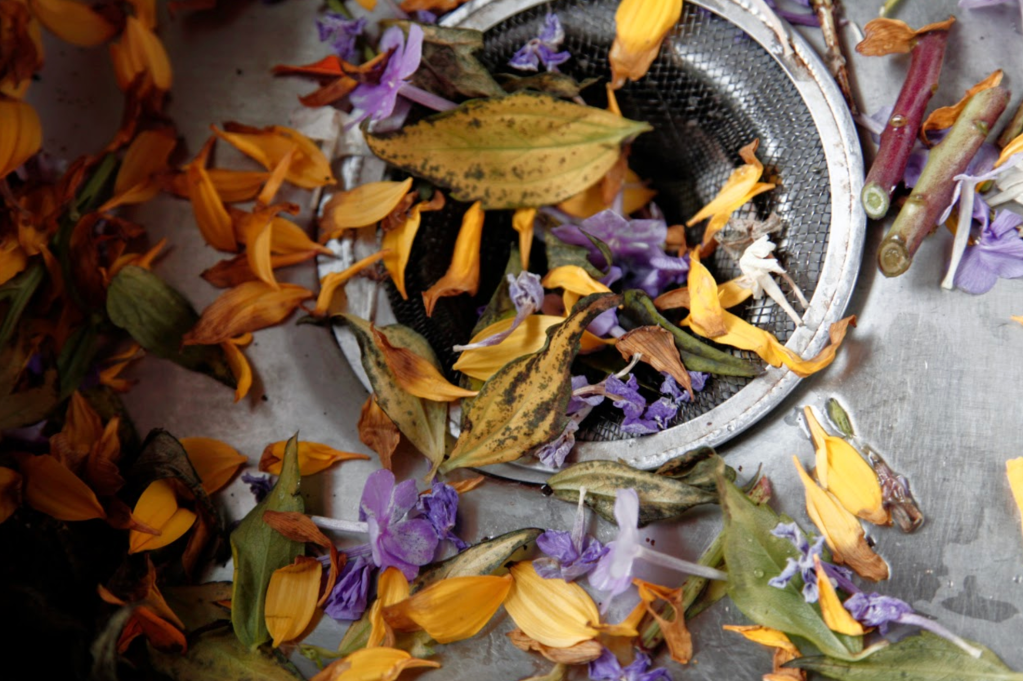
Photos are from an autumn past in Nova Scotia. The flowers were from our garden; I cut them before a hurricane blew them down.
The quotation in italics is from Claudia Rankine’s Citizen: An American Lyric (2014).
This post also appears in Substack: https://karincope.substack.com/p/why-do-politicians-love-to-defund
 Visible Poetry