“Poetry is a place where silences build articulate and meaningful architectures; it is a place where even against all hope, a poet’s job is to open the blinds to the morning, and take stock of what flies in.”
A week ago, when I wrote those words, I wasn’t entirely conscious of where they had come from or when exactly I had started associating silence, poetry and architecture as structuring forms.
I was aware that my thinking about the articulateness of silence in poetry had come from reading and watching, over many years, the work of writers, filmmakers and poets fleeing or documenting zones of war, devastation, and genocide, and poets trying to frame their rage and despair at and against regimes dedicated to misinformation and the silencing of dissent. I think, for example, of the strategies of filmmakers like Alain Renais, or Claude Lanzman, whose Shoah, used no historical documentary footage to speak of the Holocaust in Europe; of the lacunae in the work of Paul Celan or Walter Benjamin; or of Sara Uribe’s Antígona González, in which a sister searches for her brother among Mexico’s missing, turning over stones as her world turns to stone.
More recently, I could connect my sense of a poem as a way of structuring or giving architectural form to unspeakable loss to my reading of Palestinian poets, to the Gaza Poet’s Society, Fady Joudah, Mahmoud Darwish, Mosab Abu Toha, Suheir Hammad, and others. And then I found this half-written entry from two years ago in my Visible Poetry drafts folder. Why was it still there? What had called me away so that I could not finish it? The entry is still unfinished, still a draft, but then, so too is the work of listening, of making, of mourning and carrying on.
20 February 2024
I begin to read the poems of frequently-exiled Palestinian poet, novelist and editor, Ghassan Zaqtan, and then have to stop because I am weeping. How can any people bear this much loss? And still, he opens the window of the morning and calls in poetry, like air, like light, like a bird put to flight by war, but determined to return:
Wait up a bit, another moment, here
is our generation huddled under fire:
blessed be the ones who sprinkle the poem with water
and leave the heart as a lantern for a fractured horizon.
from “Slow down, girl” (1988).
The poem is written in the late 1980s, after the first Intifada, in a time when Jordan renounces its claims on the West Bank, and the PLO begins to be recognized as an official body speaking for Palestine. So much hope and so much death, so many olive harvests, so many cycles of building, destruction and rebuilding since then, so much rain evaporated into dusty air.
Zaqtan’s online biographies all say that he lives in Ramallah. Did he? Does he? Still? (Can it be said that anyone “lives” in Ramallah anymore?) Is he still alive? All of the time stamps on these biographies are old, out of date, as if poetry and news never mix. As if poetry is not, in the words of poet CD Wright, “putting yourself to the pain” of reading the news, as if it is not a matter of survival, even if you have already died.
Unspeakable sadness in glittering morning light.
24 February 2024
After digging through snow and layers of ice on the drive, I fall asleep for an hour or two on the couch with the dog, wake, and finish reading the translations of Ghassan Zaqtan’s poems gathered in The Silence that Remains. I finally understand what Fady Joudah, Zaqtan’s translator, means by what he calls “Palestinian silence.” “No silence is alone, Joudah says,” but this particular silence also fears for its disappearance, fears being forgotten, both as silence and as language inside a history of constant war and dispossession.
There is “Song of the Missing” from Zaqtan’s 1999 collection, Luring the Mountain:
One by one in the hallways
I saw them
heard their hollering
one by one
and waited
like a fling in shadow
dreaming of air
ripped
air
why
why didn’t I
shout
16 March 2026
I remember that in the notebook where I had outlined a draft of what I had written above–a notebook that is in a cupboard some 1300 kilometres away from where I am now, and which I will not be able to recover for some months–there were other poems I wanted to cite, poems that were helping me to understand not only how a poem might speak or point to [loss] or [silence] or [absence] eloquently and forcefully, but too, how clamorous the addition of one more [silence] to another [absence] to [the unspeakable emptying of the world you’d made] might be. As Mosab Abu Toha writes at the end of “Notebooks,” a poem that notes things seen during a blackout, an evacuation or another, a nightmare that plays over again and again (“We left the house/took two blankets,/a pillow, and the echo/of the radio with us”):
It’s been noisy here for a long time
and I’ve been looking for a recording
of silence to play on my old headphones.
I do not know what else I was planning to write in February 2024, but I did find a plan for the last lines of the piece. They come from a poem entitled “Spoiler” about the end of a marriage, a way of life, a mother’s life, among other things, by Palestinian American novelist and poet Hala Alyan, and they are a benediction of sorts, a prayer for making and making beautiful, even as the destiny for what you have built is rubble:
I’m here to tell you the tide will never stop coming in.
I’m here to tell you whatever you build will be ruined, so make it beautiful.
Neither living nor planting nor building are guarantees of permanence–on the contrary, we do these things because our lives and the things we make are fleeting; the best things humans make rest lightly on the earth and nourish it and others, both human and non-human. (War is not one of those things.)
Nor is to make such claims any kind of consolation for loss or destruction. Nevertheless, to speak of and into silence, as the poetry of Ghassan Zaqtan so eloquently does, is to recall not only a moment or a history of destruction, but, as well, to preserve the possibility of some kind of future. In such silences reside memory and resistance and a place for ordinary stories or a fistful of seeds, held sometimes long after a writer’s life, until the earth may again receive them.
Notes
Ghassan Zaqtan. The Silence that Remains. Trans Fady Jourdah. Copper Canyon Press, 2017.
The phrase “putting yourself to the pain” of reading the news is found in the notes to C.D. Wright’s rising, falling, hovering. Port Townsend, WA: Copper Canyon Press, 2008.
Mosab Abu Toha, “Notebooks.” Things you may find hidden in my ear: Poems from Gaza. San Francisco: City Lights Books, 2022, 88-89.
Hala Alyan, “Spoiler,” New Yorker, Sept 21, 2020. The poem can be accessed here: https://havingapoemwithyou.tumblr.com/post/782098345221046272/spoiler-by-hala-alyan?
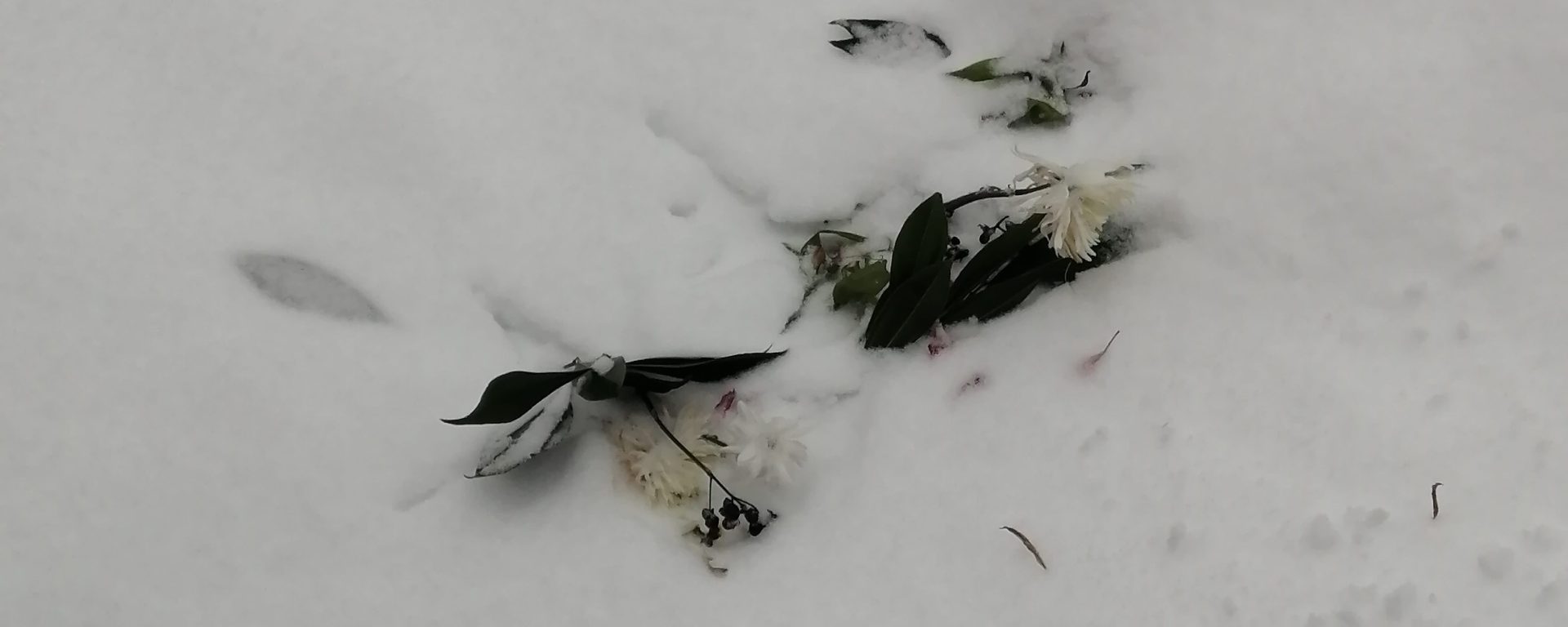
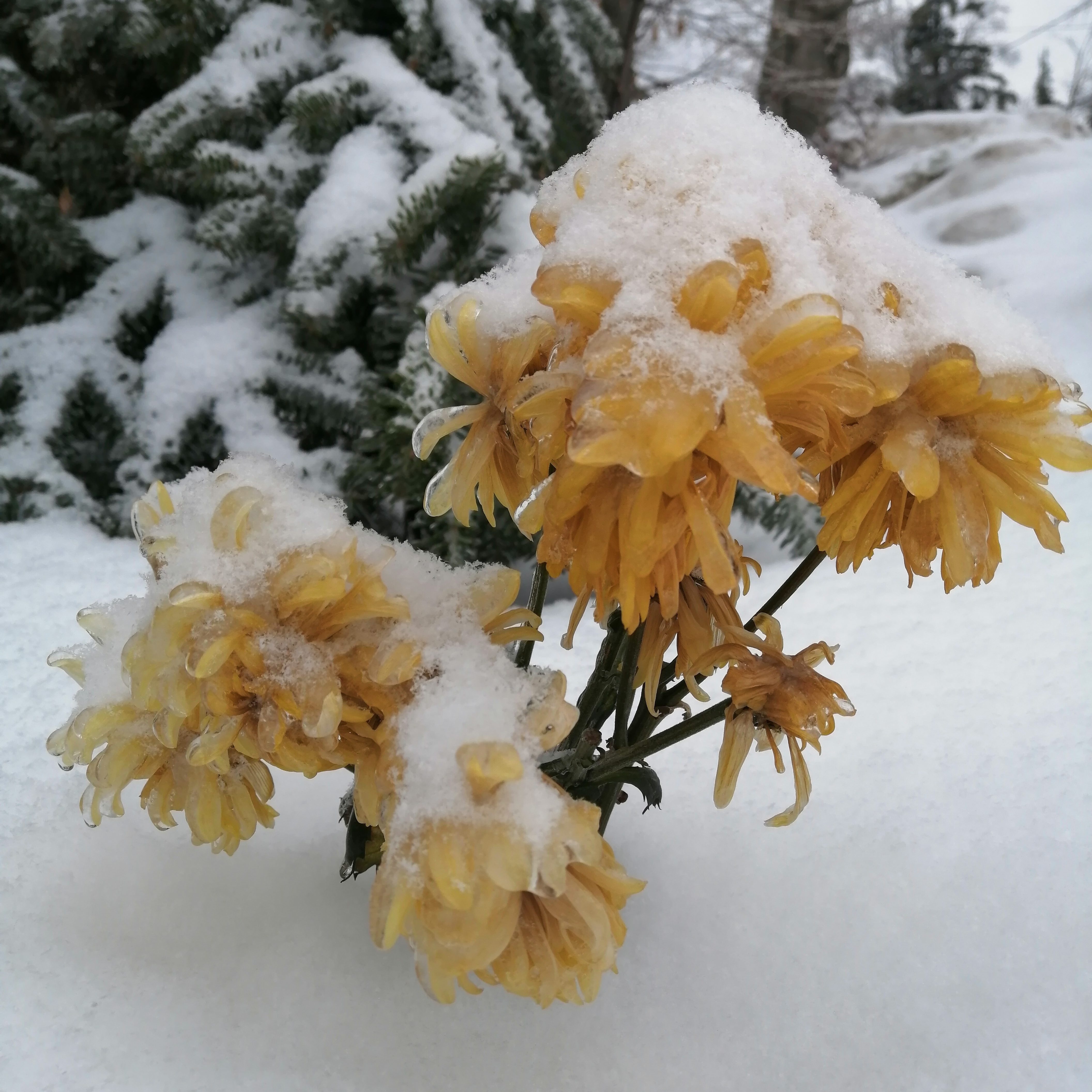
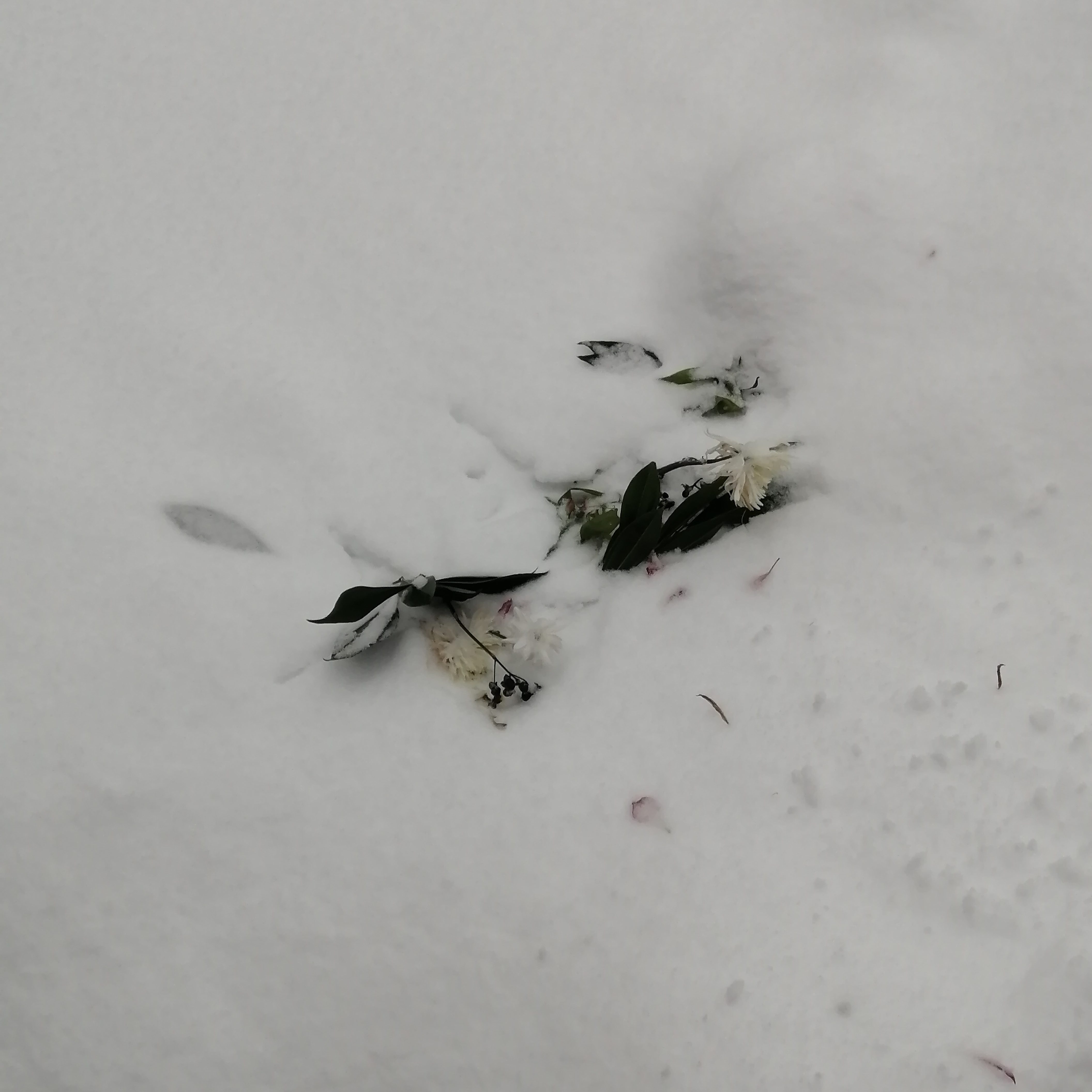
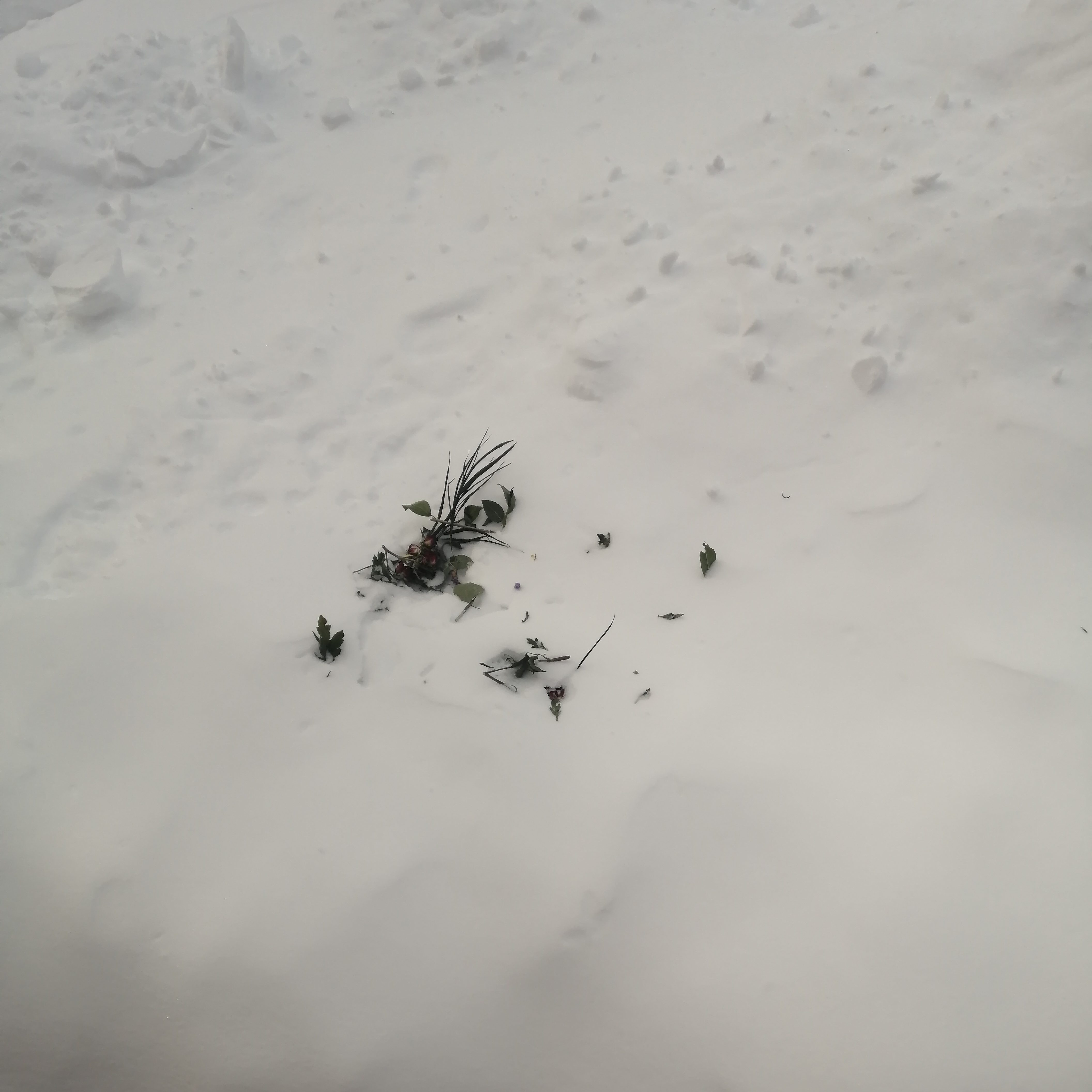
Photographs of cut flowers and leaves in snow are mine and were taken in Quebec in February and early March 2026.
I want to acknowledge that my thoughts about poetry, architecture and silence have certainly also been influenced by conversations with my art history colleague, Vajdon Sohaili, whose work on architecture, destruction and memory is careful, devastating and important.
A version of this entry may also be found on Substack: https://karincope.substack.com/p/against-all-hope-still-poetry-like
 Visible Poetry