

I don’t know about you, but I’m not sleeping much these days. I think I can manage the news during daylight hours, and when I lie down at night I do go to sleep, but then I wake with a start, wondering what fresh horrors the new day will bring, a day that has already dawned across much of the globe.
The dog tries to settle me, but my brain is having none of it; we are on the narrow ship of earth and as war and devastation and hatreds expand (including my own), being on watch and ready to respond is a calling I apparently can’t refuse, despite the fact that I am not at all sure how to respond. Listening to the news, confronting the ever-expanding lies, the incomplete lists of the dead, calculating the mounting damages, this is not my true occupation, nor will it function very long as a defense for me, which is to say, as a pretense of doing something responsive or responsible.
Yes, knowing and being informed matter, but as a poet, I reflect that at least some of the response to the horrors, outrages, confusions, dismay and grief I witness and feel must be in poetry, for poetry is a place where silences build articulate and meaningful architectures; it is a place where even against all hope, a poet’s job is to open the blinds to the morning, and take stock of what flies in.
I return, as a kind of talisman, to the words of Iranian-American poet, Solmaz Sharif, when speaking about her own practice of probing the impossible spaces of the doublespeak of war, death and border crossings:
Poetry is not a form of writing but of reading.
A way of thinking.
of being in the world….
I am looking for something that collapses the distance between
myself and what is being discussed.
That collapses time.
Something that is driven by a gaze of love and grief.
Poetry, for Sharif, is not about taking a distance, burnishing the surfaces of things or choosing elaborate forms or words; it is above all a way of offering an entrance into immediacy, a labour of tuning that makes audible a silence or truth or music hidden beneath the racket of the news and of our days. Such tuning is not an intellectual exercise, but a fever dream, a visceral, painful kind of taking stock; an urgency that nevertheless takes a great deal of time and effort to elaborate.
Here is an irony then, or an only apparent contradiction that belongs to the craft of poetry: to collapse time in a poem, to touch immediacy and intimacy, a poet must take quite a lot time with things that make us feel as if there is no time: grief, love, war, sorrow, dreams, depression, rage.
Rage is a word that Sharif does not name, yet it is an emotion that is also always there in whatever she writes, and in the “collapses” she speaks of “between [one]self and what is being discussed,” the unbearable proximities that poetry struggles to render in silences, spaces and words.
What is there to do then in these days of grief, love, war, sorrow, dreams, depression, rage and outrage? What is the work of those of us called to protest, to resist, to notice, to insist upon truths, to speak? Certainly not to take poetry for granted, or as a surplus, a way of listening or thinking that may be readily disposed of. Neither poetry, nor peace, nor care.
For poetry is a way of both taking and giving time. A kind of listening. A “gaze of love and grief.” And as African American poet Robert Hayden puts it in his poem Frederick Douglass, like freedom, poetry is “needful as air.”
In these days of expanding war then, let us not neglect poetry. Neither to read it, nor to make it, nor to share it. Poetry won’t abolish the war machine, but it can help to hold open the terms of a more honest and habitable world, a world where truths may be both spoken and heard.
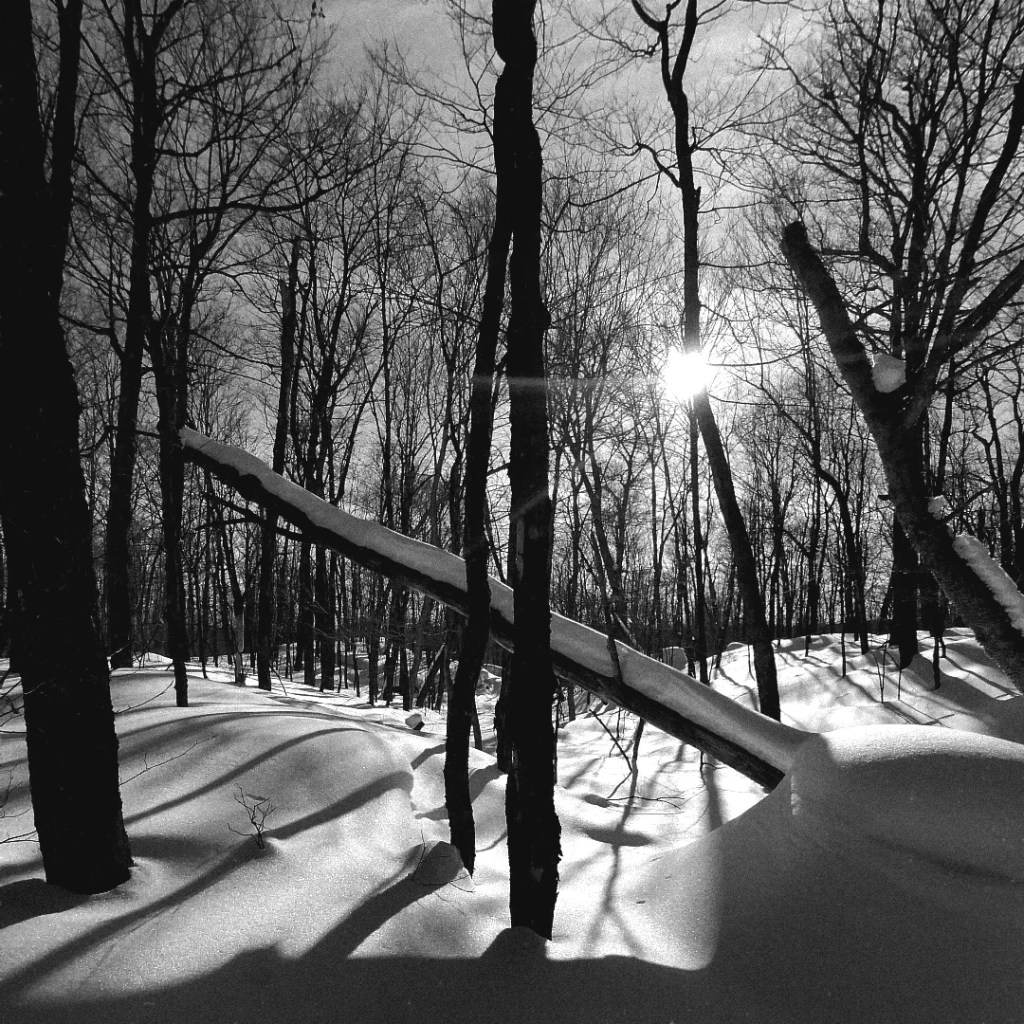
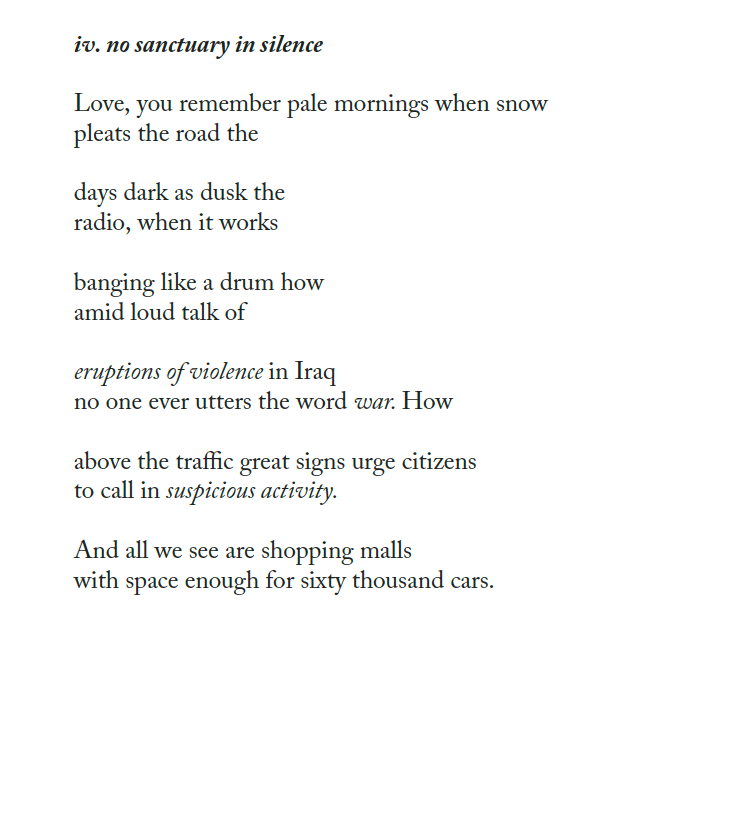
My offering for today in this emergency, a short excerpt from my just published long poem, What seas sing through our bones. If you were to change the name Iraq to Iran, or Beruit, or Gaza, or Sudan the poem might seem as if it were arriving from some future in order to recall this morning.
Notes
Poetry is not a form of writing but of reading… Solmaz Sharif, “On Political Poetry and Documents,” Asian American Writers Workshop (November 2017):
iv. no sanctuary in silence The significance of this phrase comes from the following citation: “During the war, we felt the silence in the policy of the governments of English-speaking countries. That policy was to win the war first, and work out the meanings afterward. The result was, of course, that the meanings were lost.” Muriel Rukheyser, cit. Solmaz Sharif, Look, Minneapolish: Graywolf Press, 7. Of course, Rukheyser is talking about the Vietnam War, while Sharif–and I in the poem where I allude to this citation– are talking about the second US Gulf War, the war in Iraq. Not to mention Afghanistan. What this proliferation of meaningful allusion means is that strategic silences structure wars of empire, always, and perhaps all war (uncomfortable as I am with making such a vast claim).
Karin Cope, “no sanctuary in silence,” What seas sing through our bones: Passages through Canada, the United States and Mexico. Lawrencetown, NS: Pottersfield Press, 2026, 20.
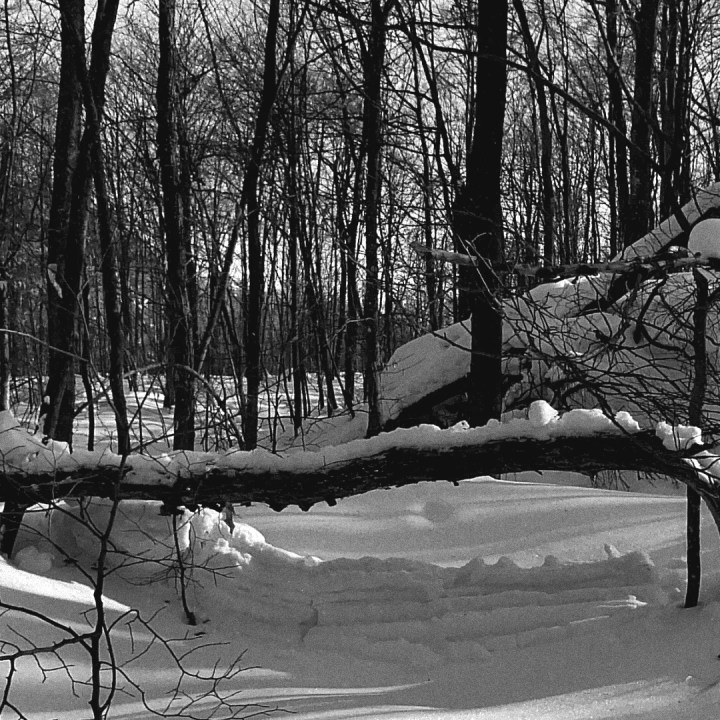
Photographs are mine and were taken in February 2026 while snowshoeing on Mont Hurtubise, Quebec.
This post also appeared on Substack:https://karincope.substack.com/p/no-sanctuary-in-silence
 Visible Poetry