13 February 2024
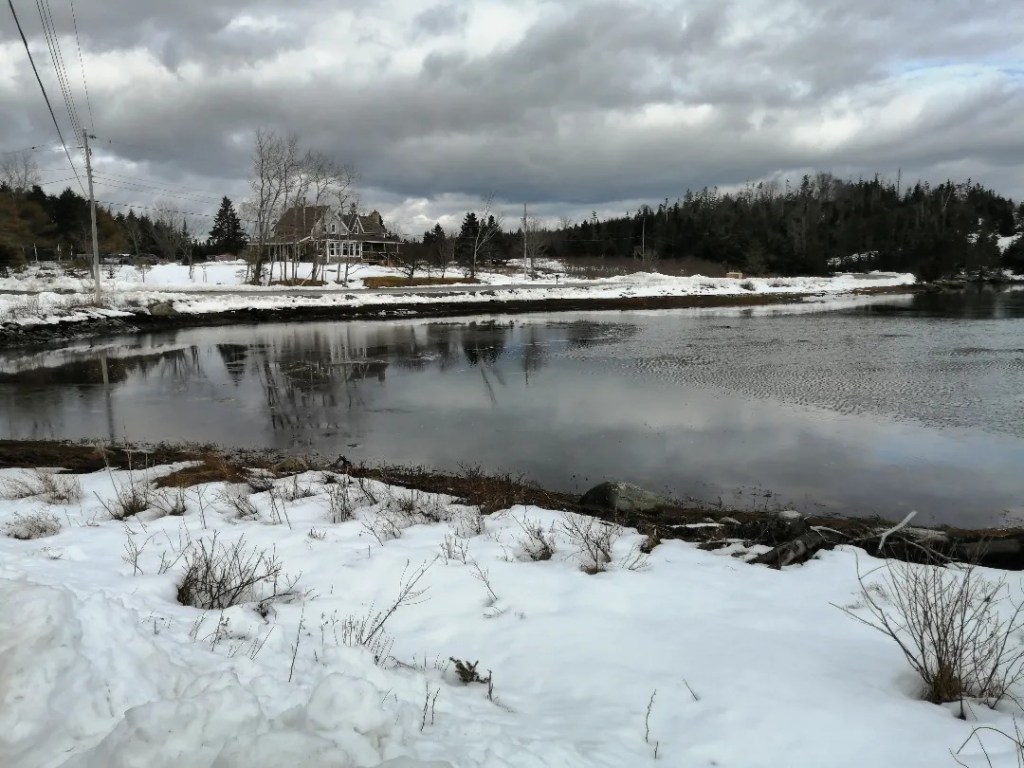
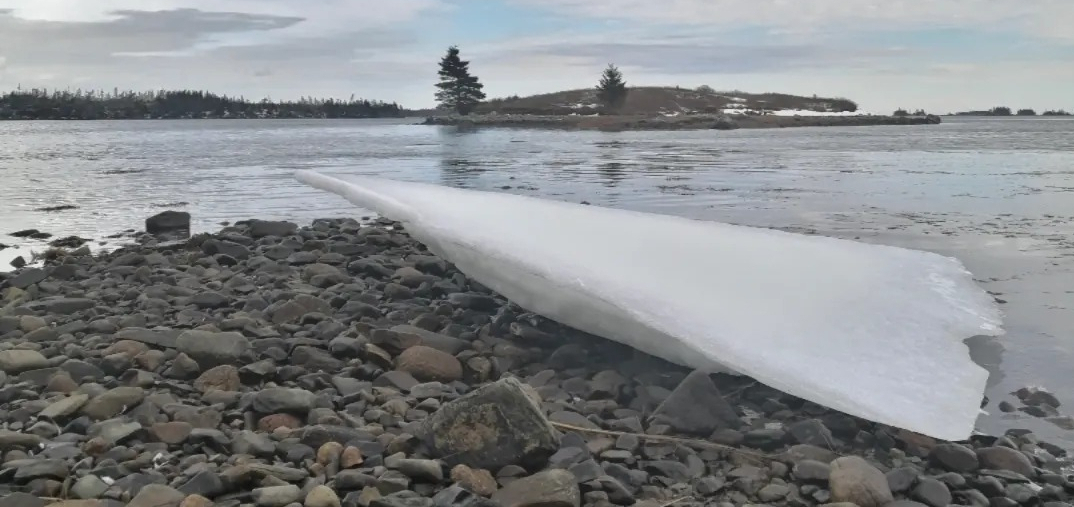
We wake to a frozen sea, a pale sun seeping through grey clouds. The rising tide breaks up a brittle skim of ice and carries drift pans, like logs, into shore. For a few moments, the icy sea turns blue with refracted light; the clouds part, and weak shadows lean across the day.
Just before I am to start a meeting at work that I have called, the power goes out. It will not come back on until the end of the morning. I cancel the meeting, standing in the cold at the edge of the porch to text a colleague, because that is the only place that I have a cell signal. My morning coffee has not yet steamed up into the pot, so for that too, I must wait.
The fire ticks in the grate and the dog and I gather near it; the morning is cold and we are waiting for a storm, another nor’easter, to burst upon us in the afternoon. But in these hours we are in the calm before the storm, and the deep quiet of a space without the constant purr and beep of devices, fans and condensers. Indoors. Outside my nerviest survivalist neighbours have set their generators roaring. It’s a lot of racket for an outage that should only last two or three hours.
I realize, perhaps not unlike my neighbours, the edges of my mind are afraid of the quiet, much like the way my body jangles just before a plunge into cold water. As if to enter into that silence will be a shock, a jolt from which any reasonable skin would recoil. If I let myself enter the silence–the way that sometimes, last night for example, I just let myself go to sleep when I lie down, instead of trying to read or to write, to prolong the day, finish my tea, stay unconsciousness just a little bit longer–what will I find there?
Sleepiness? The dog snoozes. An attention to small things: my breath; the creaking of the house beams (the wind will soon come then); the way the tide ripples through plaques of ice. Darker clouds shift across the sun.
I listen: what is here in the room with me?
First I find relief: I do not have to wind myself up to perform this morning, to build and carry a team. There is nothing I can do; no messages I can take or send; no crises I can manage. I am simply here by the fire with the dog. And a lone robin on the grass. What is it doing here so early? I worry that it will starve to death, but it picks at the spots where the ground is bare and seems to find something to eat. Then minutes later come the squadrons of starlings, sweeping the yard in waves.
Tucked behind my relief, or inside it, is a kind of sadness. Following the starlings with my pen lifts that sadness somewhat and shifts it, so that it ceases pressing like a blade at the back of my neck, and simply sits quietly beside me, where I can turn to look at it.
What is this sadness that gathers at the edges of my soul? That sits in the furniture of the day, this day, yesterday, most days, but that I treat as if it is lint or a little decorative throw, a fragment of the detritus of living?
It is that, of course–a thing built of the remains of the matter and makings of living, and it is tinged by my sense of my own mortality and that of others I love: death will be coming for some among us before too long. So it is a loss of innocence, a sense that living is a precarious state of radical impermanence, not a steady state; not the way things are. I feel my (still living 88-year-old) father’s macabre sense of humour and brutal realism echoing in my brain as I calculate: I may be closer to my own death than I was to the age I am now when I was 40. Since I will be 60 in a few weeks, I have to understand that there is an equal distance between where I am now and 40 or 80. That sort of calculation does something to your sense of self in a society that ignores and disposes of older women as if so much useless bric-a-brac. Such facts are a part of my sadness for sure, but not at the root of it. 60 is also, after all, these days for people living where I do, not so very old.
What else is here then nested in the silence sitting quietly beside me?
Regret: all the times I was not courageous enough to extend my hand to someone I wanted to help or to touch; to try something new; to push through my self-doubt and write; to send off a manuscript; to make a drawing; to call up a stranger or a friend.
Regret about my many mistakes. Small cruelties. Lies. Moments of withholding. Years and miles of preoccupation with things that really deeply do not matter.
Missing. A former partner once wrote me a short note about our breakup, which I had made quite terrible (another regret), and which coincided with the death of a mutual friend: “I miss people and I miss things.” For 30 years these words have named a heart crushing well of loss for me, a space where the world can never again be repaired. I miss those people and those things and more than anything I miss the people and places and creatures that I have loved. These days, things feel overwhelming, and less bound up with longing. My life is so full of accumulations that I don’t miss things so much except when they are signs or handholds of people and places and other beings that I’ve lost or that I can no longer reach in any meaningful way.
These are all personal losses and sorrows; some of them are very profound; every human alive for any length of time has them. But there is another element to my sadness I think. I might call it a sense of generational despair.
I do not have children–that seemed thoroughly impossible to combine with the sort of queer immigrant life that I have lived, but I have been surprised by how of late I feel an obligation to make better what I can for those who are younger than I am. This sense of obligation is quite distinct from my life as an activist, although both vocations, if we may call them that, organize themselves around efforts to imagine and change possible futures. The difference now is that I am am working within a tighter timeline, with what I hope is greater pragmatism, a sense of large systems, and against the background of a lifetime of failures.
In my lifetime, despite all of the marches and protests and reports and treaties and regulations, have people come any closer to doing away with nuclear weapons? Not really. Worse still the world may be closer to nuclear conflict and nuclear disaster than ever before.
Have we reduced or done away with war? With gender-based violence? With poverty, un- and underemployment, food insecurity, the lack of safe affordable housing, structural or casual racism, or the raging disrespect for the sustaining environment and non-human life forms? No. No. No. No. No. No. No and no.
Has citizen engagement increased? Yes and no. But so has citizen despair and cynicism. What about voter access? Not really. The end of child poverty? Definitely not.
What about decreased dependence on fossil fuels or real steps towards addressing the climate crisis? Absolutely not.
So despite a life of trying–and often working towards misguided “solutions” like plastics “recycling” instead of plastics elimination–I am every day confronted with a “world picture” as Heidegger would say that includes financial, legal and political frameworks that war upon and rip open still more corners of the earth and sea to extractive exploitation and home and habitat dispossession, thus rendering the lives millions of humans and non humans ever more precarious and impossible.
There are–and have been–many brilliant and vibrant local solutions; I have participated in a handful of them; but many large systems feel more broken and uneven than ever, whether systems of representative governance, information delivery, access to healthcare, housing and education, food security, polar sea ice or the intercontinental food webs supported by the enormous water-mixing movements of the Atlantic meridional overturning circulation.
So, generational sadness.
A life is a very short time and you can work very hard, but feel that you have gotten nowhere. On balance, I have been on the losing side of the majority of the struggles I’ve joined. For some, such a situation means that it is time to give up and sit in a recliner watching reruns or the weather disasters in between medical appointments or the next cruise. For others, it is a call to arms: what do I need to learn to do differently; where could I better put my shoulder to the wheel?
And how will I ever manage to find something worthwhile to do with this sadness if I don’t stop long enough to listen to it? If there is never enough quiet to listen to it?
To sit and watch the tide come in is also to attend to processes far larger than any life or country or system of governance; this tide will keep rising, so how do we coastal dwellers make space for it, rather than walls that will, in any event, never really keep it out? (How is it that walls so frequently pose themselves as solutions in our world? How many more reminders do we need that they are designed to fail?)
Generational sadness. I am slowly becoming something I never dreamed of–a more frail being, a seed, some clumps of earth–stepping closer to the elements, forever dreaming of transformation.
It is almost noon now, and the power still has not come on. I put more logs on the fire and watch the drift ice press against the shore. I will go for a walk with the dog and we will see what we see.
When the power comes back on, I realize that these two hours of quiet and sadness have delivered some insight and some writing. An essay even. A little thing, but perhaps it will mean something to someone.
Maybe losing power more often is a way through the chaos, hard as it is. What if it were a method, and not simply a crisis? A place where what fails (and face it, everything fails) opens the possibility for new work, new projects, new hopes, new insights?
Notes
It did not become evident to me until a few days after I had written this (after the power outage, the storm, the next shovelling marathon), that resonating in the background of what I have written here was surely Lebanese/American poet, visual artist and essayist Etel Adnan’s meditation on the movements of the tide, aging, loss, and thinking, Shifting the Silence (New York: Nightboat Books, 2020). A project undertaken in France as she approached her mid-nineties, and as she was losing her hearing, her movements were increasingly restricted and many of her closest friends dead, Adnan writes so as to hear silence as something other than absence or loss:
Silence is the creation of space, a space that memory needs to use…An incubator. We’re dealing here with dimensions, stretching inner muscles, pushing aside any interference. We’re dealing with numbers, but not with counting. Silence demands the nature of the night, even in full day, it demands shadows (69)
Etel Adnan died on 14 November 2021 in Paris, at the age of 96.
So, generational sadness, but also generational debt to those who have come before us.
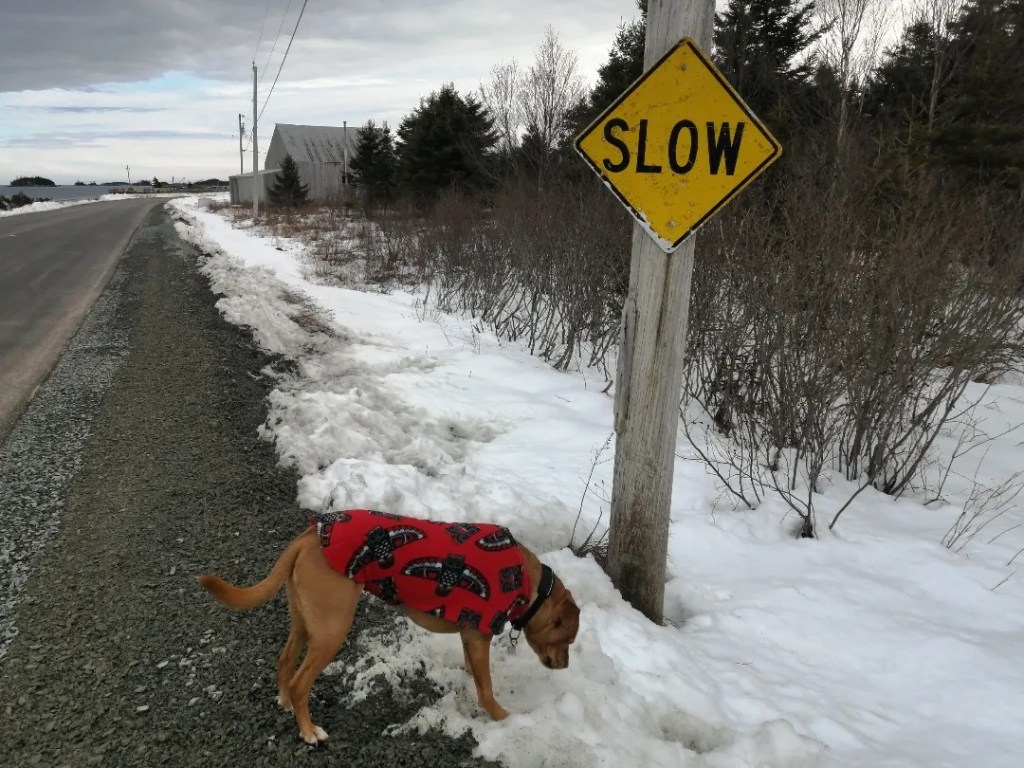
Photos were taken during my walk with the dog 13 February 2024.
 Visible Poetry
Thank you so much for these thoughts, Karin… how perfectly you have captured the strange mix of despair/hope so many of us feel, and how quiet time can agitate or soothe.
Not the first time you have spoken directly to my conflicted soul, away from the roll of the sea, but the first time I’ve tried to express my appreciation.
LikeLike
Thank you for this Janet; it matters to hear your voice back here: to feel that these words strike an echo in others, and that I am not just talking to myself before a wintry sea.
LikeLike